
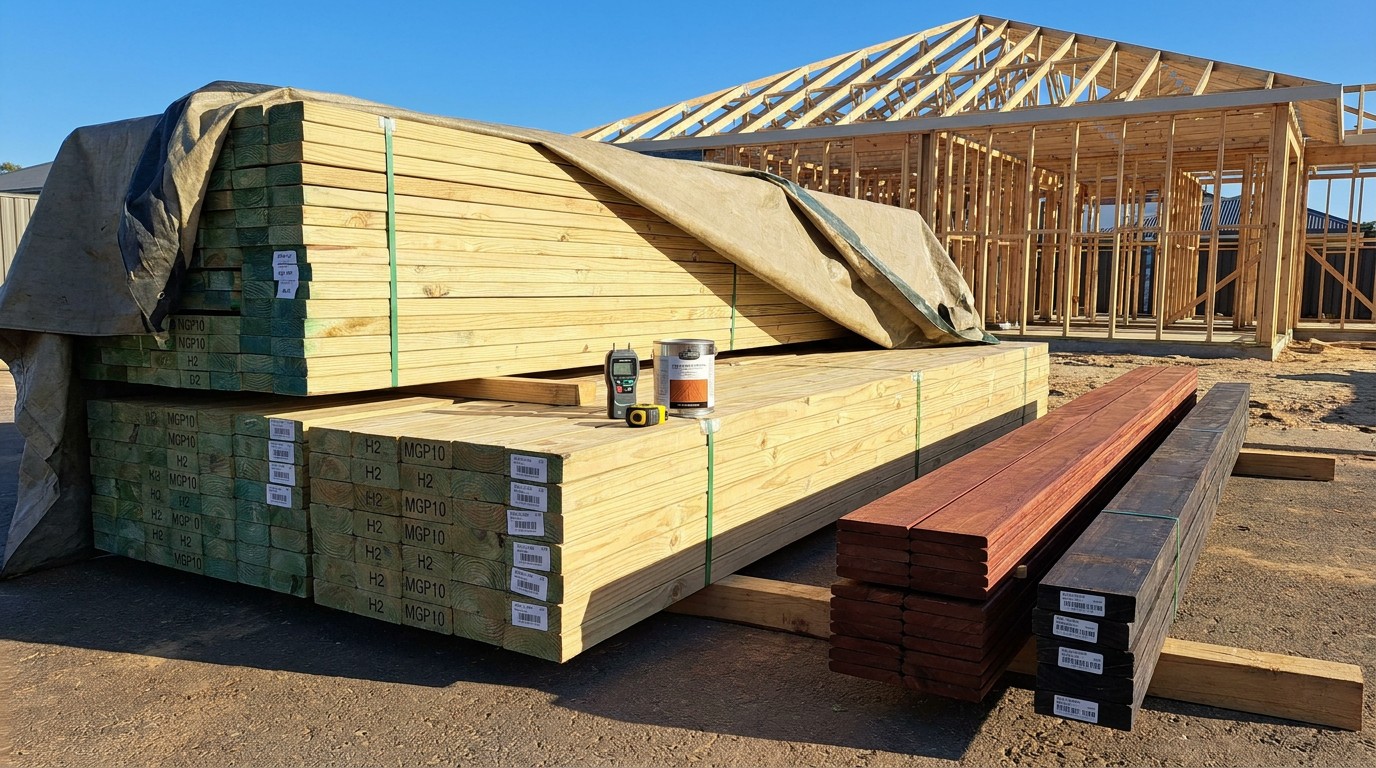
Signs It Is Time to Restock Timber for Your Next Building Project
Most builds do not run out of timber all at once. They run short gradually as stock degrades and plans shift, and by the time the pile looks empty, the delay is already locked in. Contractors look for visual signs and timing clues before the shortage reaches that point.
Stored timber is bending or cupping
Walk the rack before you walk the plan. Sight down each length from one end and check for bows along the edge, cups across the width, twists that lift one corner and splits that have opened along the grain. Boards that will not sit flat on the plates and studs that spin when stood upright will not pull straight simply because more fixings are added.
Much of this comes back to drying and storage. Kiln-dried framing leaves the yard at a controlled moisture level and should hold its shape when it is kept dry, with airflow underneath and cover over the top. Air-dried stock moves more as the weather changes and usually takes longer to settle. Old stock also behaves differently from freshly milled product because it may have been through repeated cycles of wetting and drying.
We have all kept a pack after a stage finishes, thinking it will be useful later. After months in the sun and rain, it may be bleached on top and damp underneath, with mould around the bearers and fine dust that points to insect activity. A cover that has slipped or bearers that have sunk into mud can leave the bottom boards stained, soft and unsuitable for structural work.
There is a line between rescue and restock. You can trim a checked end, remove a damaged section or cut around a bad knot, but you cannot straighten a whole pack that has taken a permanent set from poor stacking and exposure.
That timber is done, and keeping it in the main pile only makes the usable stock harder to count.
Moisture readings have drifted out of range
Your eyes will find the clearly damaged boards, but a meter finds the next ones before the problem is visible. Timber moves with the air around it and remains most stable when its moisture content sits near the balance point for local conditions. In Perth, that balance shifts between hot, dry spells and damp winter weeks, so stock that was fine in summer can be out of range by winter if it has been stored outside.
We do not guess at this. A pin meter gives a quick reading in seconds, and the result is hard to dismiss when the same pack reads high in several places. Test the middle of the pack as well as the ends, then test both faces of a selection of boards. If readings remain high or vary widely from one board to the next, the pack will not behave as a single, consistent unit in the frame.
Do not wait for visible failure. Timber that is too wet will shrink back and open gaps at joints, while timber that has dried too quickly may already contain stress that appears as twisting once it is cut. Either way, you cannot rely on it for plates, studs, joists and bearers where AS 1684 calls for stable and graded material.
Pull those lengths out of the framing pile and set them aside for blocking or general site use if they are still sound enough. Restock the structural run with fresh, even material that will take fixings without splitting. Replacing a suspect pack now costs less than opening finished walls later to correct movement or failed joints.
Offcut maths says you won’t finish the next run
Shortages often come from simple maths rather than damaged timber. Every cut leaves an offcut, while notches, defects and rejected boards consume more of the available length. We allow 5-10% for this waste on site as a matter of course, and that allowance must come off the usable total before anyone promises that the next stage is covered.
Do a quick takeoff against the next trade rather than the whole job. Count what the framers need for the walls being built now and what the roof crew will need next, then compare that with the stock you actually hold in suitable, usable lengths. If the two numbers meet with no margin for waste or rejected pieces, you do not have enough to finish the run reliably.
Yard habits affect this calculation as well. Packs buried behind new deliveries can sit untouched while fresh stock goes out first, which is the wrong way around. First-in-first-out rotation keeps timber moving before it weathers and shows what is genuinely left rather than what has been hidden at the back. If you cannot put your hand on enough straight, dry lengths for the next few days of work, it is time to order. Label packs by date so anyone on site can tell which stock should be used first.
Lead time is longer than the stock you have left
Perth yards tend to move quickly on standard framing and more slowly on special orders. Treated pine for frames is often available on a short turnaround, while jarrah, karri, marri and blackbutt can take longer when mills are busy or the required sizes are less common. Engineered members such as LVL sit in a separate queue and cannot be substituted at the last minute without new specifications. Autumn renovations also lift demand for decking sizes just as framing packs begin to thin out.
Do not compare the number of stock days left with the number of days quoted on the phone unless you include a buffer. Tell the yard which grades and lengths are needed for the next stage and ask for a firm delivery date, then work back to today from that date. Contact a yard offering Timber Supplies in Perth early to confirm lead times and grade availability before the pile gets low, rather than making an emergency purchase limited to whatever is on the shelf.
If delivery will arrive after the crew runs out, the cost of idle time is already built into the schedule. A restock placed a few days early costs much less than framers left without work or a roof crew pushed back by a week. Order while there is still a choice of species, grade and suitable lengths rather than accepting a poor substitute under pressure.
Treatment cover for termites is no longer certain
Perth and the southwest sit in a very high risk zone for termites, so treatment is more than a paperwork check. Framing pine needs the correct hazard class for its intended use, with H2 for indoor framing that must resist borers and termites and H3 for outdoor applications exposed to weather and decay. If the stamps are missing or packs have been stored for so long that the tag is unreadable, there is no reliable proof of treatment.
Cut ends matter as much as visible stamps. Every crosscut exposes untreated fibre at the end grain, and those ends need resealing or they can become a weak point for moisture and insects. Termites cause more than $1.5 billion in damage to Australian homes and businesses each year (CSIRO), which makes reusing doubtful stock to save a few lengths a poor trade-off.
We replace any length where treatment is uncertain, and we do not mix treated offcuts with untreated material in structural work. Fresh H2 stock for internal framing and fresh H3 for exposed work costs less than a call back for borer or termite damage. If you cannot confirm the treatment class, restock the length. Keep a suitable treatment sealer on site and coat fresh cuts on the same day they are made.
Pricing is moving while you wait
Timber prices do not remain fixed. Mill supply and freight costs move quotes up and down through the year, and Perth feels those changes when stock has to travel a long distance. When quotes begin climbing across two yards, that is a clear market signal. Waiting in the hope of a dip can leave the job buying near the peak with no price cover in place.
People watch quote expiry dates as closely as they inspect the timber. A price held for seven days is not the same as one held for a month, and once a quote lapses, the replacement can be higher. Buying before a known increase locks in the frame cost for that stage and helps the rest of the budget hold. Ask for written quotes and compare like with like on grade, treatment and length price. Keep older quotes on file as well, so any jump is obvious when the next one arrives.
This does not mean hoarding. Do not buy six months of timber to get ahead of a rumour, only to leave it weathering on site. Buy enough to cover the next sealed stage with the proper waste allowance included, then store it correctly and keep the fresh packs turning over.
The frame is turning into a mix of grades
Mixed piles cause failed checks. MGP10 and MGP12 do not share the same span tables, while F-grades for hardwoods have their own stress values. AS 1684 expects consistent graded material through a run, so changing grades mid-wall or mid-floor to use up leftovers can put compliance at risk. Inspectors notice this quickly when stamp colours or numbers change along a single wall.
Species and moisture condition can cause similar problems. Jarrah and pine move at different rates and hold fixings differently, while wet boards installed beside dry boards will shrink unevenly and pull lines out. LVL and plywood each have a place in long spans and bracing, and I-beams suit floors that require stiffness. They should not be patched into sawn framing without design cover. Plywood bracing and LVL lintels still require the specified fixings and gaps to perform as one system.
We consolidate each structural run around one grade from one source. This keeps the stamps legible, the spans provable and the material easier to check before installation. If using leftovers would force a mixture of grades or species, take that as the sign to restock and reserve the offcuts for non-structural tasks such as blocking and site protection.
Drawings changed and the pile didn’t
Revised plans can quietly break the original materials list. An added deck or extra load-bearing wall draws on lengths that were not included in the first order. Owner-builders encounter this when a living area grows by a metre, while builders see it when engineering changes call for larger members or closer centres.
Do not stretch leftovers to cover the new scope. Short lengths scarfed together for bearers, or joists cut from undersized stock, will not pass and will not last. Order against the revised takeoff using the correct sizes for the required spans, and include the waste allowance again for the added work. That is how the finished frame stays aligned with the approval. A fresh takeoff takes an hour and can save a week of rework.
Restocking is also a useful point to tidy up sourcing. Ask for certified stock such as FSC or PEFC where available, so the new material matches the old on paper as well as in the rack. Keep it stacked off the ground beneath a cover that sheds water without trapping damp. Leave enough space for air to move through the pack, and the timber will be ready when the trade arrives.
Restock decisions are easier when the warning signs are read early. Order clean, dry and correctly graded timber before the crew stops, and the build can continue at the planned pace.