
Heat tracing can be easy to overlook while pipes stay warm and production runs normally. Before winter, however, a change in circuit behaviour or damage to the insulation deserves attention. Finding the cause early gives maintenance teams time to arrange repairs rather than troubleshoot during freezing weather.
For plant and facility managers, the useful question is not simply whether the heating cable switches on. It is whether the cable, controls, connections and pipe insulation still work together to protect the line. These warning signs can help prioritise a pre-winter inspection.
Visible damage around cables and connections
Start with accessible sections of the installation. Look for damaged cable jackets, loose junction-box covers, damaged end seals and signs of water entering connection points. Recent work nearby is another reason to inspect: a pipe repair or insulation replacement may have disturbed the tracing or its connections.
Record the location and circuit identification rather than trying to repair an unfamiliar component on the spot. Where cable is hidden beneath insulation, an intact outer covering does not establish that everything underneath is sound. Equally, there is no need to strip the entire installation simply because winter is approaching. Let inspection findings and the manufacturer’s maintenance procedures guide further investigation.
Damaged electrical components need assessment by qualified personnel under safe isolation. Do not energise a suspect circuit just to see whether it gets hot.
Repeated trips or unexplained alarms
Repeated protective-device trips are a reason to investigate, not a nuisance to work around. Possible causes include moisture ingress, damaged electrical insulation or faults elsewhere in the circuit. The trip alone does not tell you which component has failed.
Record when the fault occurred and whether it followed rainfall, maintenance or a change in operating conditions. That history can help the technician narrow the investigation. Keep the affected circuit safely isolated pending assessment, and never bypass protection or repeatedly reset a device without addressing the cause.
Manufacturer-specified electrical testing, including insulation resistance testing where applicable, helps assess the circuit’s condition. Test methods, limits and any equipment that must be disconnected depend on the installation. Leave that work to qualified personnel rather than applying a generic test value to every system.
A change in temperature or controller behaviour
A pipe failing to reach its required temperature warrants attention even if the controller shows that heating is enabled. Check the operating record for changes in setpoints, alarms and sensor readings. Where run-time data is available, compare similar operating conditions rather than treating a colder week’s higher demand as proof of failure.
Longer operation can reflect increased heat loss, a displaced sensor or a changed process requirement. It does not automatically mean that the heating cable needs replacement. Confirm that controls are configured for the intended duty and that sensors remain correctly positioned, following the installation documentation.
For process temperature maintenance, winter checks should also account for the fluid’s operating requirements. Preventing freezing and maintaining a production temperature are different duties; a circuit that achieves one may not meet the other.
Wet insulation or uneven temperatures
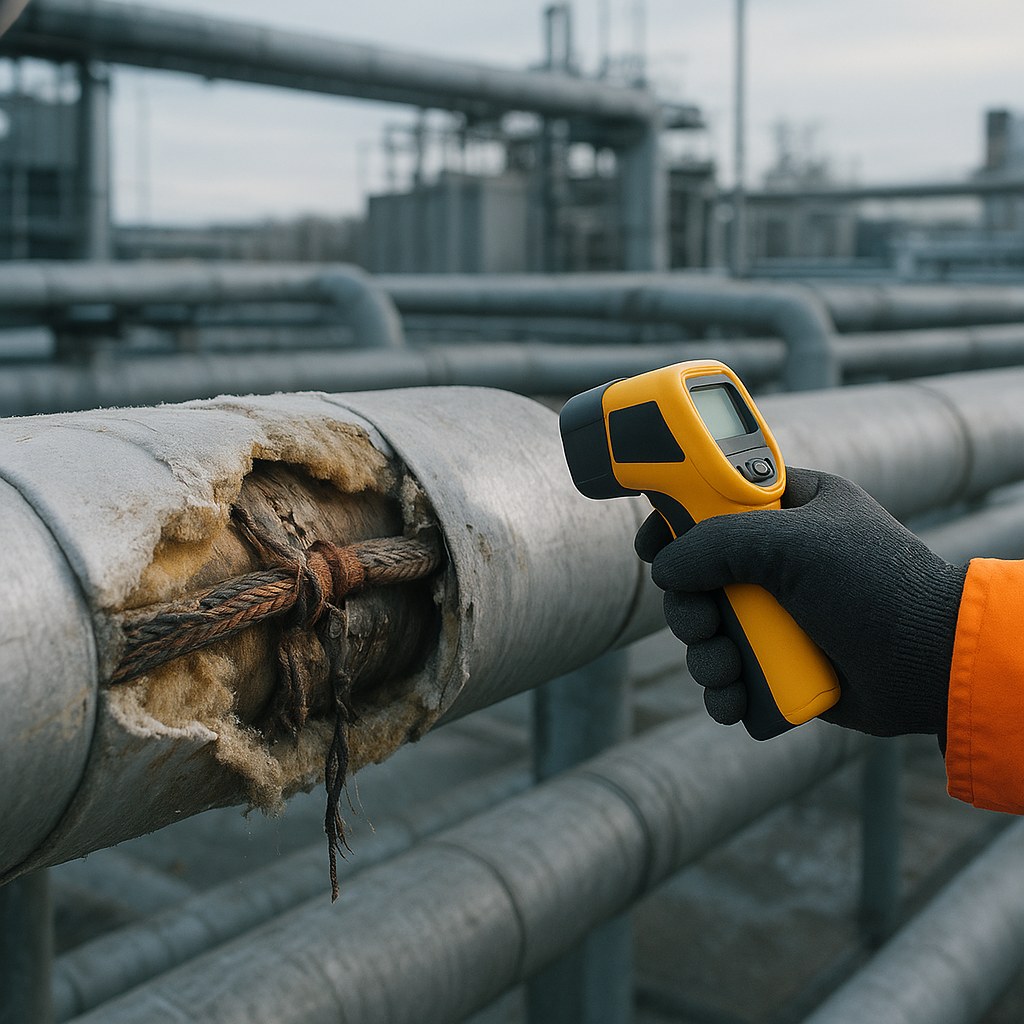
Heat tracing and pipe insulation need to be assessed together. Missing, wet or damaged insulation can increase heat loss, leaving the system struggling to maintain temperature even when the cable is functioning.
Look for broken weatherproofing, gaps around valves and supports, and staining that suggests water entry. Arrange repairs to the insulation and its protective covering, then reassess performance. Replacing cable without addressing heat loss may leave the original problem unresolved.
Temperature checks can help locate areas needing investigation, but interpret them carefully. An infrared image of outer cladding shows its surface temperature, not necessarily the temperature of the pipe underneath. Differences in surface finish can also affect readings. Where appropriate and safely accessible, qualified personnel can use pipe-temperature measurements alongside electrical tests and inspection findings. One cool patch is a lead to investigate, not a diagnosis.
Repairs are becoming frequent, or the duty has changed
Age alone is not a reason to replace a heat tracing system. A more useful assessment combines physical condition, test history, recurring faults and the suitability of the original design for today’s operating conditions.
Several repairs on the same circuit should prompt a wider review. Has the underlying cause been corrected? Have pipe routes, exposure conditions or temperature requirements changed? Are replacement components compatible with the installed cable?
If a redesign or replacement is needed, consult a heat tracing manufacturer with the application details to hand. Heat Trace’s range at heat-trace.com includes self-regulating, constant wattage and longline heating cables, alongside controls and termination products. The selection should follow the required temperature, heat-loss calculation, electrical supply and installation environment, rather than simply copying the old cable rating.
Turn the findings into a pre-winter action list
Keep inspection notes, test results, alarm history and repairs under the same circuit identifier. Assign each outstanding fault an owner and a completion date. Where a circuit must remain isolated, plan how the affected pipe or process will be protected in the meantime.
Schedule checks early enough to obtain parts and arrange qualified support. A useful inspection ends with resolved faults and documented follow-up, not just a list of warning signs.